
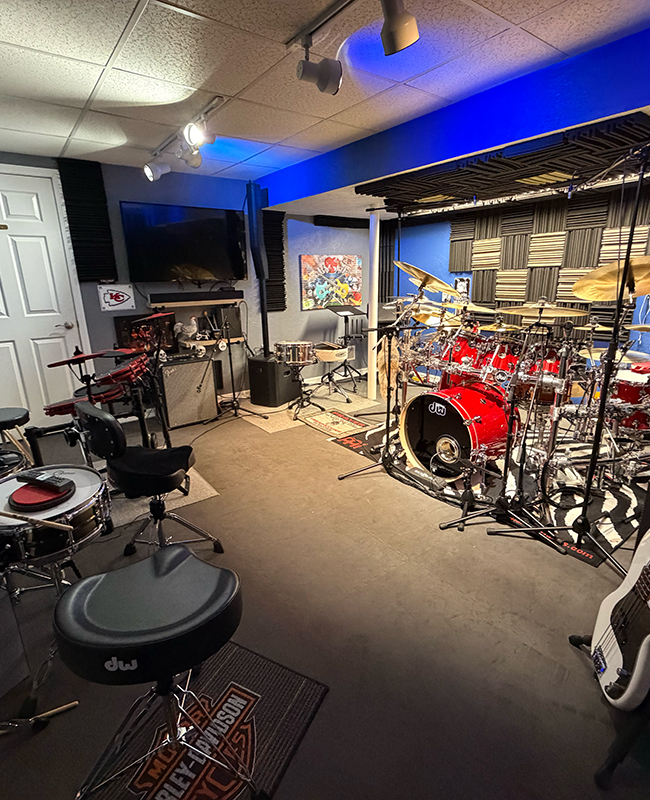

Starting with In-Person Instruction
In the early stages of learning, there are distinct advantages to having a teacher physically present in the classroom. An in-person instructor provides immediate feedback, guidance, and support, which cannot be matched by a pre-recorded lesson. This personalized attention helps learners build a strong foundation and ensures that they understand the fundamental concepts from the start.
Transitioning to Online Lessons
Once the basics have been mastered with the help of an in-person teacher, students are well-positioned to continue their education through online lessons. At this point, learning online allows individuals to progress at their own pace and explore topics that align with their personal interests. This combination of in-person and online instruction creates a flexible and effective learning experience.
Your own personal portal ♩ ♫ ♬
When you join me for a 1 on 1 Drumming class, you also get a personal portal for all your lessons and other media perks.
Having a personal portal for your lessons and media makes tracking progress and staying organized a lot easier.
Introduction
What should a beginner drummer learn first? Starting your journey as a drummer requires focusing on fundamental skills that establish a strong musical foundation. Below are the first concepts every beginner should work on when learning to play the drums.
Proper Stick Grip and Posture
The initial step for any new drummer is to develop proper stick grip and posture. Holding the drumsticks correctly is essential for control and comfort, while maintaining a healthy posture helps prevent fatigue and injury during practice and performance.
Learning the Basic Rock Beat
After mastering stick grip and posture, beginners should learn the most basic rock beat. This beat consists of playing the hi-hat on all eighth notes, the kick drum on beats 1 and 3, and the snare drum on beats 2 and 4. Practicing this pattern helps build coordination and familiarity with common drum rhythms.
Using a Metronome
Playing with a metronome is crucial for developing steady time and improving coordination between your limbs. It trains you to maintain consistent tempo, which is an essential skill for all drummers.
Mastering the Single Stroke Roll
Another important exercise is mastering the single stroke roll, which involves alternating strokes between the right and left hands (RLRL). Begin practicing this roll on a practice pad to build evenness and control, then apply it to the full drum kit as your technique improves.
Are Drums Hard to Learn for Beginners?
The difficulty of learning drums as a beginner varies depending on several factors. While the experience may differ for every individual, it is generally true that drums can be a challenging instrument to play. This is largely because drumming demands a high level of coordination and skill.
What Makes Drums Challenging?
For those just starting out, mastering the basics of drumming requires patience. Beginners must be prepared to dedicate time and energy to practice regularly to develop the necessary techniques and improve their abilities. Consistent effort and perseverance are essential for overcoming the initial difficulties and making progress on the drums.
Getting Started with Drumming
After learning some of the basic techniques. The most effective and quickest method to improve your drumming skills is to start playing real music. By actively engaging with songs, you immerse yourself in practical application, which accelerates your learning process and helps you develop a sense of rhythm and timing.
Playing Along to Favorite Songs
Choose songs that you enjoy and play along using various beats, fills, and musical ideas inspired by more experienced drummers. This hands-on approach allows you to practice and refine techniques in a fun and engaging way, while exposing you to different styles and methods that can enhance your abilities.
Learning from Others
It is important to remain humble and recognize that there is always something new to learn. By keeping an open mind and being willing to learn from others, you can continuously improve and grow as a drummer. Embracing feedback and new ideas will help you become a more versatile and skilled musician.
When Starting out...
You don’t need to know how to read music to play drums, especially when you’re starting out. Many drummers begin by learning patterns, beats, and rhythms through ear training and by following along with songs or teachers.
However, learning to read music, specifically drum notation, can be incredibly helpful as you advance. It opens a wider range of opportunities, such as playing with other musicians, reading sheet music for specific parts, and understanding more complex rhythms. It can also give you an advantage in more formal settings like bands, orchestras, or studio work.
For a beginner, focusing on stick control, basic rhythms, and coordination is more important than reading music. But once you’re comfortable with the basics, adding music reading to your skills will be valuable in the long run. Do you already read music, or are you just starting out on drums?
In my class for stick control training, I focus on a few essential rudiment sticking patterns to build technique and coordination. Some of the main ones I teach include:
1. Single Stroke Roll:
Right-left-right-left (RLRL) and Left-right-left-right (LRLR). This is a fundamental pattern to develop even hand control.
2. Double Stroke Roll:
Right-right-left-left (RRLL) and Left-left-right-right (LLRR). This helps with control and speed, emphasizing smooth alternation between the hands.
3. Paradiddle:
Right-left-right-right (RLRR) and Left-right-left-left (LRLL). This develops hand independence and is very useful in a lot of drumming styles.
4. Flams:
A single stroke with a grace note right before it. Flam patterns build control over subtle grace notes, adding flair and dynamics.
5. Five Stroke Roll:
A five stroke roll is played like this (RRLLR).
6. Triple Stroke Roll:
A more advanced variation where each hand plays three strokes in a row before alternating (LLL) (RRR).
Ringo Starr, John Bonham, Chad Smith, and Buddy Rich
These are just a few famous players who never took lessons and who most likely never read a musical note. Legend has it Buddy Rich would listen to the band play the tune once, then he'd jump on the kit and play it. No chart, no notation.